I recently received this text which got me to thinking that a post on how egg color works may be in order.

Clearly, her expectation was that the egg color from which the rooster had hatched would immediately have an effect on the color of the eggshell of any egg fertilized by that rooster. (We are not going to get distracted by the fact that her blue-egger hen is laying white/cream eggs.)
That would be awesome if we could get results so quickly! But alas, that is not how it works.
The White One, whom we called Mr. O’Malley, hatched from a lovely green egg, similar to these.
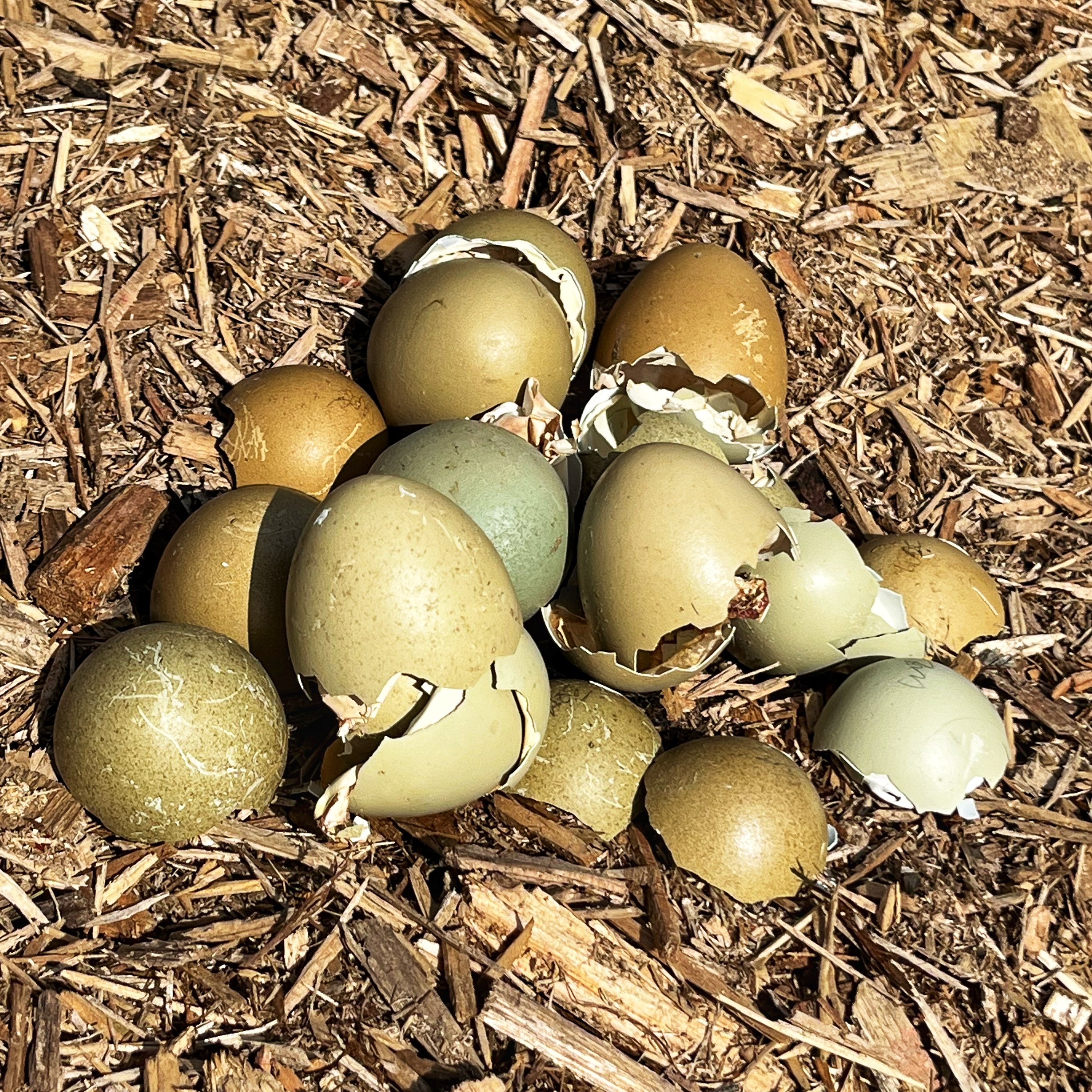
When Mr. O’Malley contributes to a hen’s egg, his green egg genes will become part of his daughters’ egg color recipes. His daughters will lay eggs that are influenced by his egg colors. His hen however, will continue to lay the color that was established in her genetics by her parents.
This is the fun part of curating an Olive Egger Flock: selecting the prettiest eggs to hatch and then selecting the prettiest grow-outs to keep for next year’s flock refresh. Right now I have an Olive Egger Rooster and a Welsummer Rooster (dark brown eggs with spots) covering Bright Blue Egger Hens and Olive Egger Hens.
Olive Egger Rooster over Bright Blue Egger Hen should give me chicks that will lay bright green eggs.
Welsummer Rooster over Bright Blue Egger Hen should give me chicks that will lay medium green eggs with speckles.
Olive Egger Rooster over Olive Egger Hen should give me chicks that will lay mossy green eggs.
Welsummer Rooster over Olive Egger Hen should give me chicks that will lay dark green eggs with speckles.
You can learn how to reserve chicks from my Olive Egger pens here: How to Reserve Chicks. And, yes, Happy St. Patrick’s Day! May your eggs be green!

“Hey, I purchased Olive Egger hatching eggs from you and the eggs you gave me are blue?! What’s up with that?” or “Hey, I purchased Olive Egger chicks from you and they grew up and are laying brown or blue eggs. What’s up with that?”
”Thank you for asking. It’s complicated.”
I saw this on PostSecret today, and wanted so much to contact the person who sent it in. Clearly, he or she imagines that the word “Fertile” on the label indicates that there is a developing chick inside — see the little picture he or she drew in the yolk?
A Wheaten Olive Egger is a hybrid of Wheaten/Blue Wheaten/Splash Ameraucanas and Wheaten/Blue Wheaten Marans who will lay lovely medium to large olive eggs, often with speckles. The birds are lovely and sweet, and can have with muffs, or beards, or feathery legs, or all three!
This is the fun part of curating an Olive Egger Flock: selecting the prettiest eggs to hatch and then selecting the prettiest grow-outs to keep for next year’s flock refresh. Right now I have an Olive Egger Rooster and a Welsummer Rooster (dark brown eggs with spots) covering Bright Blue Egger Hens and Olive Egger Hens.
What makes my Olivers special? The birds I chose to start the flock with.
Olive-colored eggs that is. Today I found this in the nesting box . . .
Olivers eggs lay in all the shades of green, from minty to khaki. And the birds are just as pretty as the eggs!
My friend Kristy sent me this pic of an Olive Egger egg with a blue inside — isn’t it gorgeous? Even better, I was able to order some hatching eggs.
Every wonder why sometimes your hard-boiled eggs peel really well and sometimes they don’t? Freshness. A too fresh egg won’t peel nicely. As all our eggs are fresh, this can be a problem sometimes. Solution? Instant Pot.
Toasty Eggshells coming right up!
Eggshells provide the perfect calcium supplement for our hens. As we use eggs, we toss the shells onto a baking sheet lined with parchment paper which we keep in the oven. When we preheat the oven for baking, the eggshells toast to a lovely brown. Once smashed to smithereens, they are mixed in with the table scraps and served to our layers. Easy and thrifty.
Skelter! It’s just fun to say.